

Raggo: AI assistant with cited sources
Raggo is the artificial intelligence assistant we build at Coresis to answer with an organization's own knowledge. It searches authorized documents, websites, courses, videos, and databases, writes the answer, and cites the source of every fact, so anyone can verify it in one click.
It runs on language models deployed in the client's infrastructure: content and conversations are not sent to external AI providers. When the answer is not in the sources, it says so instead of making it up.
Key capabilities
Answers with sources
Every answer includes numbered citations that link to the original document. Verification does not depend on trusting the model, but on opening the source.
It says "I don't know" when it doesn't
If the content does not hold the answer, it reports it with a clear message and logs the question as unanswered. That list shows which documentation is missing.
Permissions before search
Restricted content is never queried, so it cannot leak into an answer. Groups come from the directory the organization already uses.
Models on your own infrastructure
The AI models run inside the organization, so documents and conversations do not leave for external AI providers.
Search in Spanish and English
People can ask in one language and find content written in the other; the answer comes back in the language of the question.
Sources always up to date
Synchronization with each source runs on a schedule and only processes what changed, so the assistant does not answer with outdated information.
When a private RAG like Raggo fits
Raggo fits when an organization has a lot of knowledge spread across manuals, regulations, courses, videos, and portals, and the same questions arrive again and again by email or chat. A classic search engine returns lists of links; Raggo returns a written answer with the sources that support it. It is built on retrieval-augmented generation (RAG), the approach in which a model first retrieves authorized content and then answers with it.
It does not fit when the task is to take actions in other systems, such as registering a case or approving a request: that belongs to AI agents with controlled tools, and when the work requires retries and evidence of every step we run it on AquilaMesh. Nor does it replace getting the content in order: if the documentation is outdated, the first job is to clean it up.
How Raggo works
The process has three steps. First, the sources are connected: files are uploaded, or the website, course platform, videos, or databases are linked. Then Raggo reads and organizes that content to understand what it means, not just the exact words, and at that point the organization defines which groups of people can query each source. Finally, users ask from a chat widget installed on the site with two lines of code, or from a search page with filters, and receive answers that link to the source.
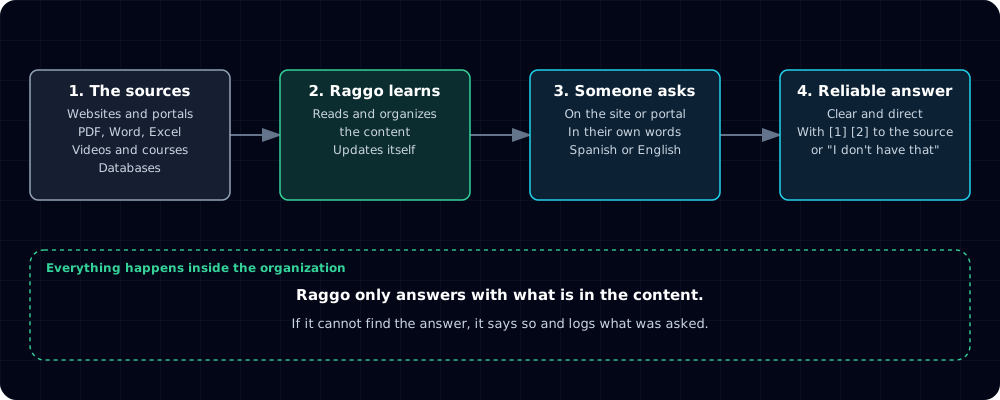
The chat widget can be customized with a title, a greeting, and a color. An analytics dashboard shows what people ask, what could not be answered, and which content should be created or updated.
Data security and privacy
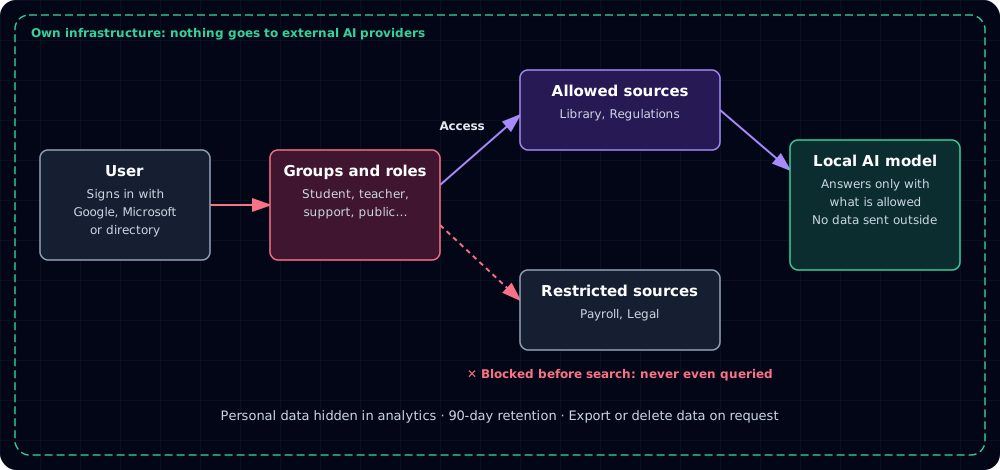
Raggo was designed so that data stays inside the organization:
- AI models on your own infrastructure. Conversations are not sent to external AI providers.
- Permissions before search. Restricted content is not even queried, so it cannot appear in an answer.
- Sign-in with the current identity. Google, Microsoft, or the corporate directory; existing groups define what each person sees.
- Privacy by design. Personal data hidden in analytics, 90-day retention, and export or deletion on request.
Supported connectors and formats
Raggo includes connectors for Drupal, Moodle, H5P, YouTube (through transcripts), websites, SQL databases, and file upload. It reads PDF, Word, PowerPoint, Excel, CSV, HTML, and plain text or Markdown. If the organization uses another source, we build a custom connector.
Quality measured in internal tests
Before promising results, we measure them. These are the figures from our internal tests:
| Indicator | Result |
|---|---|
| Search quality (nDCG@10) with reranking | 0.93, versus 0.86 without reranking |
| Out-of-content questions correctly rejected | 100% |
| Search time with reranking | ~0.4 s |
| Typical time for a complete answer with citations | 6–9 s |
The figures come from controlled tests on the Coresis innovation lab infrastructure, on a server with an NVIDIA RTX 5080 GPU. The evaluation used a synthetic corpus of 110 records in Spanish and English, with 90 questions the content can answer and 8 it cannot, so rejection was measured as well. These are not client results: we repeat the evaluation with each organization's real content during the demo.
Frequently asked questions about Raggo
Are documents sent to OpenAI, Google, or another company?
No. Raggo works with AI models that run on the organization's infrastructure, so content and conversations are not sent to external AI providers.
What happens if the answer is not in the documents?
Raggo replies with a clear message saying it found no information and logs the question as unanswered, to identify which content is missing. It does not make up data.
Can someone see information they are not allowed to see?
No. Permissions are applied before searching: restricted content never reaches the model or the answer. Groups can be taken from the Google, Microsoft, or Active Directory directory.
Which languages does it support?
Spanish and English, with cross-language search: a person can ask in Spanish, find content written in English, and receive the answer in their own language.
How is it installed on a website?
The assistant is added with two lines of code and customized with a title, greeting, and color. There is also a search results page with filters.
How long does it take to get started?
It depends on the sources and the available infrastructure. In the demo we review the case and propose a realistic plan; we prefer not to promise timelines without knowing the content.
Decision guide
How to evaluate an AI assistant on your own content
An assistant that answers from internal documents is only useful if its answers can be verified, it respects what each person may see, and it does not make things up when information is missing. Before comparing models, review sources, permissions, infrastructure, and how quality will be measured with real questions.
Libraries and universities
An AI search engine for resources, regulations, and courses, in Spanish and English, with filters and cited answers.
Support and internal teams
An assistant that resolves frequent questions from employees or customers with current documentation.
Government and citizen services
Information on procedures and services that can be queried in natural language, with access control and traceability.
How it fits in the architecture
A person's identity defines their groups, and the groups define the allowed sources. Over those sources Raggo searches by meaning, reranks the results by relevance, and hands the context to a model running on the organization's infrastructure, which writes the answer with citations. Connectors keep the content up to date, and the analytics dashboard records what people ask and what goes unanswered, without exposing personal data.
What to validate before adopting it
- Inventory the sources, their owners, and how often they change.
- Define which directory groups may query each source.
- Prepare real questions, including some the content cannot answer.
- Confirm the infrastructure to run the models and the retention policy.
When not to choose it
If the goal is to take actions in other systems, the right piece is an agent with controlled tools, not a question-answering assistant. If the documentation is outdated or has no owners, the assistant will repeat those problems faster: the content needs to be put in order first. And if questions are solved by finding a single document, a well-configured search engine may be enough.
How Coresis applies it
Raggo is a Coresis product. We connect it to Drupal portals, course platforms, and document repositories, and we validate it with each organization's real content before proposing a plan. When the case calls for product agents we use Dify; for delegated work with control, AquilaMesh; and our AI agency provides the guidance.
Demo and related technologies
Book a demo with your own documents on WhatsApp or through the contact form. We show you Raggo in action and tell you honestly whether it fits your case.